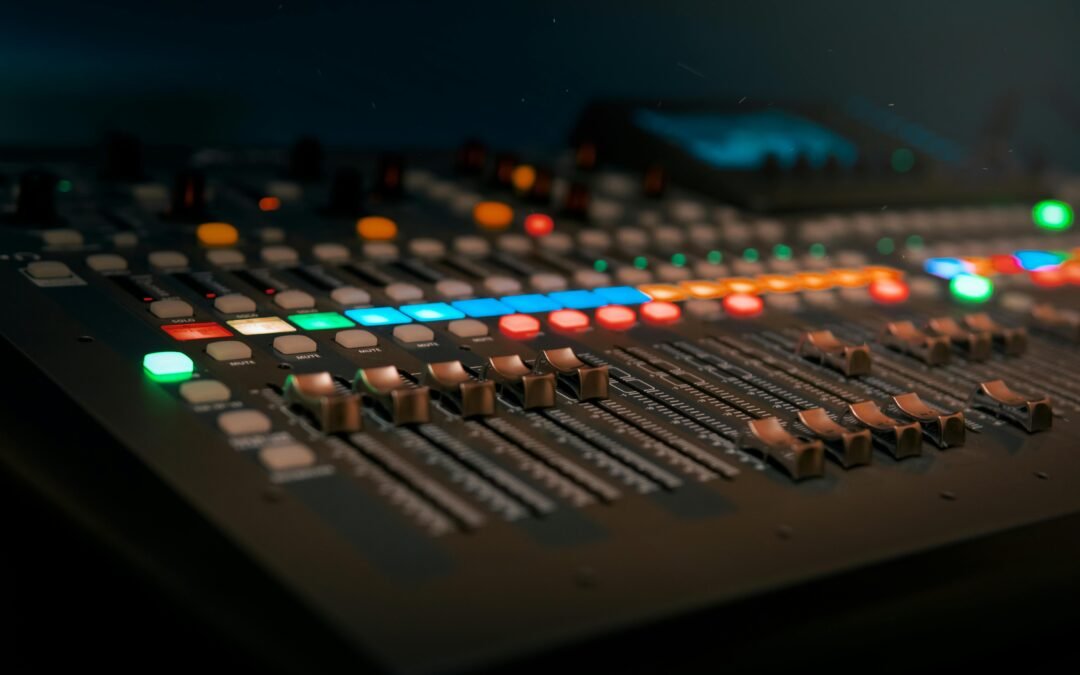
It seems contradictory, but it’s true: Despite high-capacity, low-cost data backup, we are losing fragments of our past every day.
PHOTO: Chris Pelonis
( Please take note that this article first appeared in the Mix magazine in August. )
Maybe back in the mid-2000s, my brother-in-law Rick turned me on to a book called How the Irish Saved Western Civilization, by the best-selling writer Thomas Cahill. It’s a fun read as far as famous, traditional nonfiction goes, and though its claims may be overstated at times ( certainly there were others working on the same thing ) and its views may skew in favor of St. Patrick, St. Augustine and another, its basic idea is good. And that premise is this:
When the Roman Empire was falling, ushering in the Dark Ages, education, and most certainly the recording and preservation of knowledge, fell out of fashion for the next 600 years or so. In light of this, the new monastic orders of Ireland, which were based on a foundation of education and the promotion of knowledge, began using their contacts on the continent to smuggle every piece of text they could find to Ireland. There, over the next half a millennium, from the Isle of Man in the east to the shores of Galway in the west, monks and scribes began copying those books and scrolls—over and over and over. That’s how the Irish saved Western civilization
A couple of things have recently appeared on my desk that have given me an entirely new perspective about those monks. Maybe, I thought, they loved their work, excited to be a part of the world’s first large-scale information backup. As long as it was properly preserved and then transferred with care to whatever distribution and storage systems might emerge in the future, it may be that they realized that the simple physical storage medium of ink on paper was forward-compatible with the Rosetta Stone and early pictograms and backward-compatible with the end of the human race.
READ MORE: Editor’s Note—Making the Connection.
The news story from late in June that Paramount had quietly shut down the MTVnews.com website, only to have it become a major story, was the first thing that made me reevaluate the monks. Where did the 30 years of unique music news, journalism, photography and videos go? Was it gone forever? We’re still in the throes of the fallout, and the site’s writers and personalities became outrageous and went public. Future-focused pundits made comments, and other music websites chimed in. In 2019, MySpace was back in the news with something similar, admitting that it had irreversibly lost 12 years worth of music and photos, affecting 14.2 million users and 53 million tracks. Just gone.
The media and entertainment industries, admittedly on a smaller scale, experience similar circumstances every day. After the new corporate owner assumes charge of storage, a small-town newspaper shutters its digital archive to reduce costs and is unable to locate its physical assets. You’re unlikely to find anything today unless you save a physical copy of that particular issue, which might have been an early-nineties regional punk music zine.
The third in a series of recent pieces on Iron Mountain’s technological efforts surrounding the storage, preservation, and archiving of music and media assets was reading this month’s feature by senior writer Steve Harvey,” It’s Time Talk About Hard Drives,” which made me rethink the monks. It was a bit shocking, but not too surprising, to learn that during a recent inventory survey of media assets, they found that 20 percent of hard disk drives were unreadable. It’s not Iron Mountain’s fault, the drives were brought in that way and there’s only so much they can do if a disk does n’t spin or a root system file is corrupted. If a song from the mid-to-late ‘ 90s was recorded, mixed, mastered and distributed all-digital, never touching a physical medium, there’s no guarantee that it will play back in 2024, or that the assets will ever be recovered.
Robert Koszela, director of North American Studio Operations at Iron Mountain, has seen it all in nearly 30 years as a media archivist, from issues with tape through today’s most up-to-date preservation and restoration technologies. He’s not up late at night worrying about doomsday scenarios, and he does n’t believe the sky is falling—so when he issues an industry-wide call for awareness and action regarding digital storage and playback, it’s best to pay attention
I’m not a chicken little either, and I’m not in favor of returning to paper storage and lab-reported photos. I believe that with a little digital and physical sleuthing, many assets can be recovered.
However, it’s also true that the majority of people today mistakenly believe that their information is digital and accessible forever when they click Save or Send. That’s simply not true. The term” the digital dark age” was first used in the mid-’90s to explain the contradictory idea that we are actually losing significant amounts of historical data every day as storage grows in capacity and prices year after year. That makes no sense, yet it’s true.
All you can really do is pay attention to your assets and make sure to future-proof them for all future formats is at the end of the day. Then backup, backup, backup. If that proves too time-consuming, you might try asking a monk for help. They have a solid track record.
Native Instruments is releasing Traktor Pro 4 now. It’s been a long time ( 6 years, in 2018 ) since Traktor Pro 3 came out. The criminal element of today’s Traktor Pro 4 launch date dates back to 2014, the year the Kontrol S8 and Stem Decks initially appeared in the DJ program. Native Instruments has introduced plant parting research in this updated version of the program, breaking down your lines into individual components and making them accessible, effectible, and mixable.
Some people saw this as a vision when Traktor released the Pro 2 with Stem Decks in 2015, and in many ways, this is it. Advances in modern music control algorithms have made on-the-fly plant separation a fact rather than having to purchase Stems files made by the producers and labels.
Traktor Pro 4 is available today, right now. We’re able to sell it digitally, so if you want to support DJTT, you can upgrade it here or purchase it here.
Traktor Pro 3 upgrade costs$ 74.50, or you can purchase a license for just$ 149. It’s not a cheap investment, but we are happy to see that the new killer features are n’t locked behind a subscription model. They’ve also added previous subscription-only features – Pattern Player and Ozone Maximizer – into the base software – so if you’ve missed out on those features in the past, they could be right for as a one-time upgrade.
Is this distinct from stem separation in other DJ softwares?
Yes, in terms of the technology behind it, this is different – but the result is very similar. The Stem separation engine from Native Instruments sounds pretty good, so I asked them to explain more about the technology behind it. I was concerned that it might have incorporated some of the internal software tools from their merger with iZotope in 2021. Sure enough – here’s what they said:
Traktor Pro 4 features stem separation powered by AI, and iZotope’s powerful RX technology. We ca n’t provide too many technical details, but we do have the same upgraded machine learning as the new RX 11, which is based on the most cutting-edge neural network, plus our own pre and post-processing to increase the separation quality. We’ve chosen settings that work well across all genres and have chosen to prioritize quality over speed for Traktor. To maintain consistency and simplicity across the entire collection, we are not currently exposing these settings.
The Stem separation from NI sounds similar to Virtual DJ’s Stems 2.0 and Serato DJ’s Stems 2.0. When I tested all three side-by-side, I was pretty shocked that they were so similar, despite clearly all being based on different tech. ( Worth noting I did n’t have a ready-to-test version of Algoriddim djay as they’ve also put a lot of work into their algorithm, – but I plan to later today ). Most stem separation has actually reached the point where it’s acceptable for most DJs to use it in the mix, but it’s not perfect on its own.
Stems analysis takes a while, in my initial tests, averaging 30 to 40 seconds of processing per minute of song separated. I asked NI to provide a little more information to see if this would lead to further optimization, and they responded:
The current implementation is CPU-based, and optimized for CPU-processing ( as opposed to GPU). We could add more parameters in a future update to give users more control over the speed and quality tradeoff, but we’re eager to hear more feedback about the feature since it comes with Traktor Pro 4.0.
How flexibly can the stems be mixed?
Here’s the thing: Native Instruments invested years in creating a complete ecosystem to support Stems mixing. We’ve all heard of DJs who manually re-run their collections in the software before using Traktor 4. The implementation has n’t changed here – DJs see the main waveform on the bottom of the deck, and it’s made up of the individual 4 parts that Traktor splits them into ( Drums, Bass, Other, and Vocals ).
From my perspective, Traktor Pro 4 has the most flexible Stems mixing controls on the market – with per-Stem volume, filter, and FX send, all of which are MIDI mappable. Again, it’s not a big surprise here because it they’ve had this workflow for a long time, with only the built-in analysis and separation being new.
You can access the files as multi-track MP4s in Traktor’s data folder in your OS if you wanted to get experimental, but there is no simple way to do this.
Restoring obsolete hardware that was previously used to make stems ( S8, D2, S5 ).
The new release adds a brand-new feature to a number of different hardware pieces that have been discontinued by NI, which is incredibly intriguing. The Kontrol S8, Kontrol D2, and Kontrol S5 all show individual Stems Decks waveforms. I asked NI to tell me if they planned to return any, and they responded:” Yes.
Any piece of hardware that has dedicated stem controls for our stems can be controlled with ours. Let’s see how our user base reacts to the new features and take it from there, although there are no plans to revive the D2 and S8 right now.
I’ve kept a casual but keen eye on Kontrol D2 prices over the years since they were discontinued—and the used market has been very expensive for out-of-production hardware. My best guess is that this will only increase prices even further—they’ve hovered at around$ 499-$ 699 (original release price was$ 499 in 2015 ).
Similarly, I asked about” club-standard” gear compatability – as Stems have somewhat struggled to get into big DJ booths without a good way to quickly control them. Will HID integration with other gear, such as mixers and CDJs, gain some Stems features if the D2s do n’t return anytime soon?
Update the mappings in the future is likely to result in this. But to bring the 4 waveforms onto industry standard displays, we will be depending on the support of the device’s manufacturers.
The other big feature: flexible beatgrids (! )
Traktor Pro 4 now includes flexible beatgrids. This request on the Native Instruments docket must be the longest in existence; I can recall reading it as one of the main things DJs wanted to see in a upcoming Traktor version.
Well, at long last, it’s real. Grid Markers now have their own associated tempo, and Traktor Pro 4’s flexible beatgrids precisely follow each tempo change throughout a song. You can manually add your own tempo zones and change the tempo of each, and yes, live-played tracks can be gridded as well by adding a marker every 16 beats; this process feels a lot like turning the knob on a track in Ableton Live.
Traktor Pro 4’s future
I also inquired about the Traktor team, any updates that might be related to Maschine/Stems, and the potential future Traktor roadmaps ( given that there was a fairly open roadmap revealed with Stems and flexible beatgrids ). Their response was promising, if currently vague:
Over the past year, the team has grown, and the Traktor ecosystem has a long way to go. We made the decision to not include our Traktor roadmap with this release. In the interim, we’ll be carefully analyzing feedback and setting development priorities accordingly.
Alright – now back to the lab for a bit more testing. Again, if you want to upgrade to our store to support DJTT, you might as well upgrade to the new version of Traktor Pro 4.
Stay tuned for a new mapping for the Stem Decks for the Midi Fighter Twister and Traktor Pro 4!
Film music, often called the “invisible actor” of cinema, plays a crucial role in shaping the emotional and narrative experience of a movie. From the iconic opening notes of “Star Wars” to the haunting melodies of “Schindler’s List,” the power of a film score lies in its ability to evoke emotions, build tension, and create a lasting impact on the audience. In this blog, we’ll explore the art of film music, its evolution, and its profound influence on storytelling in cinema.
The Origins of Film Music
The relationship between music and film began in the silent film era when live musicians accompanied screenings to enhance the visual experience. These early performances ranged from solo piano or organ to full orchestras, with musicians often improvising or following cue sheets that outlined specific moods for different scenes.
As technology advanced and synchronized sound became possible, the role of music in film evolved. The introduction of “talkies” in the late 1920s allowed filmmakers to integrate music directly into the film’s soundtrack, giving rise to the original film score. This development marked the beginning of a new era where composers could craft music specifically designed to complement the narrative and emotional arc of a film.
The Evolution of Film Scoring
Over the decades, film scoring has undergone significant transformations, reflecting changes in both technology and artistic trends. The Golden Age of Hollywood, from the 1930s to the 1950s, saw the rise of symphonic scores, with composers like Max Steiner, Erich Wolfgang Korngold, and Bernard Herrmann creating lush, orchestral soundscapes that became synonymous with classic cinema.
In the 1960s and 1970s, film music began to incorporate more diverse musical styles, from jazz and rock to electronic and experimental sounds. This period gave birth to iconic scores like Ennio Morricone’s work on “The Good, the Bad and the Ugly” and John Williams’ unforgettable themes for “Jaws” and “Star Wars.” These scores not only defined the films they accompanied but also became cultural touchstones in their own right.
The late 20th and early 21st centuries have seen an even broader range of musical influences in film, with composers like Hans Zimmer, Trent Reznor, and Hildur Guðnadóttir pushing the boundaries of what film music can be. Whether through the use of electronic beats, minimalist motifs, or unconventional instruments, modern film music continues to evolve, adapting to the changing landscape of cinema.
The Role of Film Music in Storytelling
Film music serves as an emotional guide for the audience, subtly influencing how viewers perceive a scene or character. A well-crafted score can heighten tension, underscore romance, or evoke a sense of wonder. It can also provide narrative clues, foreshadowing events or revealing hidden aspects of a character’s inner world.
One of the most powerful aspects of film music is its ability to create motifs or “leitmotifs”—recurring musical themes associated with specific characters, places, or ideas. John Williams is a master of this technique, using leitmotifs to great effect in films like “Star Wars,” where the “Imperial March” instantly signals the presence of Darth Vader, or in “Harry Potter,” where the “Hedwig’s Theme” evokes the magical world of Hogwarts.
Moreover, film music can transcend the visual narrative, resonating with audiences on a deeply personal level. Think of the tear-inducing score in “The Lion King” or the uplifting melodies of “La La Land.” These pieces of music often stay with the audience long after the film has ended, becoming a part of the cultural zeitgeist.
The Collaborative Process
Creating a film score is a highly collaborative process, involving close communication between the composer, director, and sometimes even the actors. The composer must understand the director’s vision and translate it into a musical language that enhances the storytelling without overpowering the visuals.
This collaboration often begins with spotting sessions, where the director and composer watch the film together to identify key moments where music should be placed. The composer then works to create a score that aligns with the film’s tone and pacing, often revising and refining the music in response to the director’s feedback.
In some cases, directors and composers form long-lasting partnerships, such as the collaborations between Steven Spielberg and John Williams or Tim Burton and Danny Elfman. These relationships often result in a deep mutual understanding that allows for the creation of truly memorable film music.
The Impact of Film Music on Popular Culture
Film music has a unique ability to transcend the medium of cinema, becoming a significant part of popular culture. Iconic themes like the “James Bond” theme, the “Mission: Impossible” motif, and the sweeping score of “The Lord of the Rings” have all become instantly recognizable, even to those who may not have seen the films themselves.
Beyond individual themes, film music has also influenced other art forms, from concert performances to video game soundtracks. The popularity of film music concerts, where orchestras perform scores from beloved movies, speaks to the enduring appeal of this art form. Additionally, the rise of streaming platforms has made film scores more accessible to a global audience, allowing fans to enjoy their favorite movie music anytime, anywhere.
Conclusion: The Timeless Power of Film Music
Film music is more than just an accompaniment to the visuals; it is a powerful storytelling tool that shapes the emotional and narrative experience of a movie. From the grand orchestral scores of Hollywood’s Golden Age to the innovative sounds of contemporary cinema, film music continues to captivate and inspire audiences around the world.
As technology and filmmaking continue to evolve, so too will the art of film music. Whether it’s a soaring symphony or a minimalist electronic beat, the music of the movies will always have the power to move us, connect us, and leave an indelible mark on our collective imagination.
SYNTH ANATOMY uses affiliation & partner programs ( big red buttons ) to finance a part of the activity. If you use these, you support the web. Cheers!
The new, affordable, touch-sensitive synthesizer, The Theremin, was inspired by the famous Theremin synth.
More than a year has passed since the NAMM present. With the exception of Korg, there was no other significant oscillator scene. With its innovative Stylophone Theremin and CPM DS-2, the American company Dubreq was able to draw interest.
The Theremin is then accessible despite taking a little longer.
Feature Shows
Control with your system
Portable
Drone or set information
Built-in speech with level manage
Built-in vibrato and wait effects
Connect any wired headsets and other products together
device powered
The standard Dubreq site today offers 109 and 95€ plus shipping.
Depending on your site, it boats from the EU, UK, or US inventory. It will appear after at merchants.
Accessible for pre-order at my companion:
Perfect Circuit
Content From January 5, 2024
One of the first, if not the second, instruments was the Theremin. Invented in 1920 and patented in 1928 by Leon Theremin. Synthesizers with white and black keys did n’t debut until much later. The Theremin’s unusual operation continues to be outstanding today.
You move your hands along two antennas, one for volume and the other for ball, instead of the classic keys. a skill that requires constant practice. Dubreq, the engineers of the latest Stylophone variety, have now brought their unique Theremin onto the market.
Stylophone Theremin
The Stylophone Theremin, aka Pitch Theremin, is never a 1-to-1 copy or duplicate of the original product. It has a slightly different idea and features its individual.
Like the classic, Dubreq’s Theremin is also a touch-sensitive Synthesizer that creates appears by detecting your activity. Yet, with a big difference! It’s just a pitch-only Theremin, so it only has a second antenna. The volume (VCA ) antenna is missing, making it easier to play.
His position model’s behavior is not the only thing that makes this unique. You may change the volume and sound on the Stylophone Theremin through a comprehensive control panels. Analog or digital, not 100 % evident. But I think it’s digital.
The website features three components: good generation/play, a pause, and a slider/trigger. You can adjust the angle of the slide and the antenna in the first. The synth consists of a two-wave oscillator ( sine/square ), a decay envelope, a vibrato effect, and a drone mode. The update switch allows for FM.
With the transmitter and the slider, which have fixed pitches, it can be played traditionally empirically. Since you have a” slider mixer”, you may definitely enjoy both side up. With the cause option, you can also play sound without using the transmitter.
Additionally, you can way the noise into a pause with period and feedback controls. According to Dubreq, it even hosts a built-in speech and can be mounted on a speaker stand. A microphone socket and a key output are provided on the link side.
The creators promise quick, moving empirical sound. ” Wave your hand around its antenna, move its slide from side to side, and go over the border with mad modification, wobbly vibration, and crunchy echoing wait for crazy, quirky, sci-fi sound development”.
Second Idea
It takes years to learn how to play a true Theremin, and to practice with it artistically requires times. That’s why some demos usually sound very empirical. I like the idea of simplifying the design by eliminating the level antenna.
The ability to adapt sound is excellent as it turns the” Theremin” into a more versatile-sounding equipment. However, a screen is missing. Sometimes we will see it in an MK2 edition. Even thumbs up for the cost. All in all a beautiful, interesting Synthesizer.
Stylophone Pitch Theremin is available immediately for roughly$ 110, 100€ or £90. Without making a payment upfront, you may pre-order items from the official site.
Following five years of growth, Z&H Designs has unveiled the HVC250 five-band statistical equalizer.
Z&H Designs HVC250 Parametric EQ
New York, NY ( August 2, 2024 ) —Based in the UK, Z&H Designs has unveiled the HVC250 five-band parametric equalizer. Z&H engineers spent five years redesigning the traditional wiring of the original, which finally produced many of the necessary components in-house, in the soul of the highly sought Sontec MEP-250.
The HVC250 loop architecture features 14 separate, high-voltage par amp, which outperform conventional IC par amps in terms of throughput and dynamics. Features include consistency range: 15 Decibels to 25 hertz, S/N amount > 96 database, distortion: < 0.0015 % ( 20 Hz to 20 kHz ).
The speed bands—which overlap and can be individually bypassed—are stated as Low speed: 15 Decibels to 800 Hz, Low-mid speed: 15 to 800 Hz, Mid regularity: 160 Hz to 8 kHz, High-mid frequency: 450 Hz to 25 kHz, and High frequency: 450 Hz to 25 kHz.
A Mix Solution of the Week is the Metric Halo MBSI Channel Strip.
The LF and HF rings can also be set to an EQ slope of the kind found in the LF and HF bands, and each group has a 12 mysql boost or cut capability. The “air” and” sub” band shelf options mimic the LF and HF features of the initial Sontec unit while the narrow speed settings enable surgical efficiency. A high-voltage ( 56V ) linear power supply ensures high dynamic range and headroom, and minimizes noise.
As with all Z&H Designs items, the HVC250 is handcrafted and tested, and each product features names from the two professionals who perform QC. Choices include switching dials and 6dB boost/cut. A mastering edition of the HVC250 with detented handles is also being planned by Z&H Designs.
A 14-day trial time is available, and the HVC250 includes a five-year insurance.
We covered the first reports from last year regarding how parent company of Pioneer DJ proposed a commercial merger of Serato Audio Research. Now, there’s been big news that may decrease the bargain to a end: New Zealand’s competitive governmental agency, the Commerce Commission, has denied clearing for the package.
The first agreement, which is estimated to be worth$ 59 million US, was deemed a done deal by many in the sector. However, the potential monopoly situation that would result from the merging of the two companies was heightened by extensive publicity and criticism from inMusic ( Denon, Numark, Rane, and others ‘ parent company ).
The Overseas Investment Office reviews and approves any offer that is more than$ a specific dollar amount and involves an outside company acquiring a New Zealand-based business. The Commerce Commission ( or ComCom for short ) appears to have had the final say in the approval of the deal. The selection meeting was reportedly pushed back at least four days, but they eventually made it public today.
Here’s a few choice passages from ComCom’s determination to rise, posted on their website:
The Commission, according to Chairman Dr. John Small, was never satisfied that the merger would have the effect of significantly reducing competition in the markets for DJ applications and DJ hardware.
According to the Commission’s investigation, Serato and Rekordbox engaged in close competition with DJ technology. We did not consider the competition level that may result from the consolidation to be as high as the other DJ software providers, or the possibility of a new DJ application provider entering the market in the near future. So, we could not remove the real possibility that the merger would lead to significant cost increases for consumers and/or a lower-quality software offering, Dr. Small said.
We also expressed concern that the proposed acquisition would significantly lessen competition by making it more difficult for DJ technology vendors to contend with Pioneer DJ. The integration could give ATC the ability to either eliminate or worsen DJ hardware adversaries ‘ ability to integrate their goods with Serato because Seratato is a significant piece of software for DJ technology companies to integrate their DJ equipment materials with. We also expressed concern that the merger would give ATC access to its DJ hardware rivals ‘ economically sensitive information, including information about unpublished products shared during the integration process, giving ATC a competitive advantage and reduce the pressure on both ATC and its competitors to innovate.
However, when there is a fear of monopolies, it’s difficult to obtain regulatory approval because both companies play a heavy role as both hardware and software in the sector.
What then for Serato and AlphaTheta?
But, what happens next? Hopefully Serato’s justification for entering this transaction was n’t out of concern for being acquired. A lot of the time, a essentially sound but financially unstable company will get acquisition to provide their buyers and assets a good way out. Editors ‘ Update July 18: Serato has reached out to ensure that everything is running smoothly on their front:” Here’s a offer from the CEO:
While it’s not the choice we wanted, the Serato organization has never been in a better position, and neither has our relation with AlphaTheta. Through the process, we have n’t abandoned what we do best, and our network of upcoming innovations, including those involving jobs with AlphaTheta and other business partners, is incredibly strong.
Fresh Ly, CEO, Serato
There’s a possibility that the firm might attempt to relocate to a nation with less business regulation, but doing so would be a significant expense.
Considering Pioneer DJ / Alphatheta’s many years working closely with their large investment capital owners (KKR ) with deep pockets, we suspect that it’s probably a bit of a surprise to not get what they’re after. Maybe the alternative would be to have a very strong and healthy cooperation between the businesses. It’s difficult to speculate too much about the acquisition’s genuine purpose, but perhaps AlphaTheta has the chance to permit some of Serato’s team’s software prowess and incorporate it into their hardware offerings.
What do you think about the DJs benefitting from this offer constriction? Please leave a post below.